

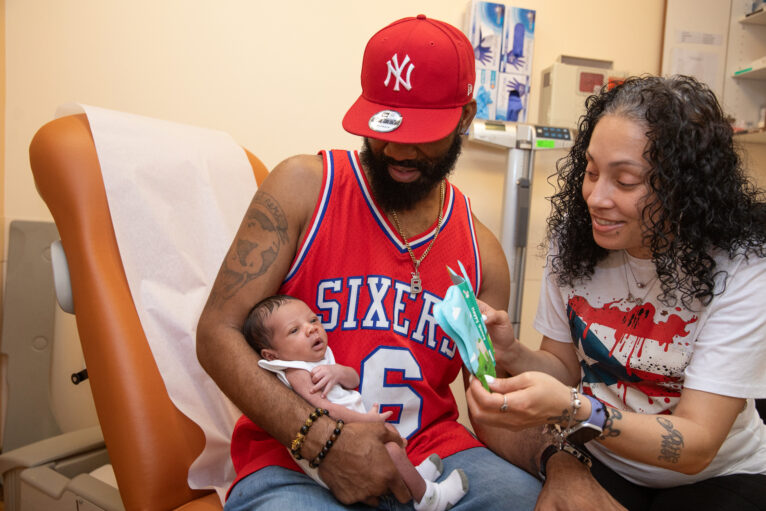
The 5-year-old had been watching. During a well-child visit in Florida, Dr. Rocio Martinez-Ange shared a book with a family’s 2-month-old baby, showing the parents that reading at this age could mean pointing at pictures, laughing, singing, or following the baby’s gaze. At a later visit, the baby’s mother said the 5-year-old had picked up the book at home and begun reading to the baby, imitating what the clinician had done. “It felt like a full-circle moment,” Dr. Martinez-Ange said. A clinician had modeled an interaction, a sibling had absorbed it, and a baby too young to understand the words was now at the center of a new family routine.
There is something usefully strange about talking about reading with a 2-month-old. A newborn cannot follow a plot or anticipate what happens on the next page, but strip shared reading of everything we eventually associate with literacy and what remains is the foundation of a relationship. A baby hears a familiar voice, studies a face held close, directs attention toward something, and gets a response. The book gives the interaction somewhere to gather.
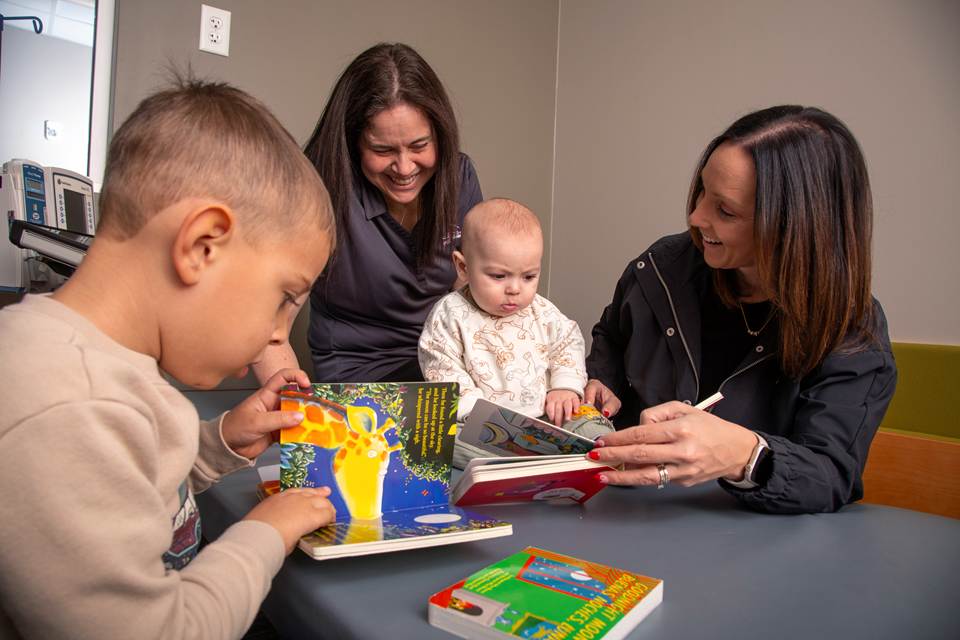
That understanding is at the center of Building Connections Begins at Birth, Reach Out and Read’s work to start its evidence-based model into the earliest well-child visits. The Louis Calder Foundation currently supports this effort in five Affiliates across seven states, with a goal of 40,000 well-child visits and 40,000 books. The proposition remains intimate. Talking, singing, sharing books, and responding to a baby are already part of healthy development.
“The earliest months of life are full of moments that shape how babies learn, connect, and grow,” said Reach Out and Read CEO Lynette Fraga. “When Reach Out and Read begins at birth, we can help families recognize the power of those moments from the very start — and give clinicians a simple, tangible way to nurture the relationships at the heart of healthy development.”
At Bright Pediatrics in Catoosa County, Georgia, Dr. Alexandra Townes has watched parents put that idea into practice before the appointment is over. “When I give a book to my newborn through 5-month patients, parents get so excited to open it and play with their child in the room during the exam,” she said. With 4-month-olds, she sometimes shows families how to combine tummy time with reading time.
Tummy time matters for early motor development, but it can be difficult when a baby dislikes the position. Books designed for tummy time can stand upright at floor level, placing high-contrast images, faces, and mirrors in a baby’s field of view. The baby has something worth looking toward while a caregiver points, talks, and responds beside them. Research suggests visual stimulation and caregiver engagement can help babies tolerate the position. The family has a tool that can help make the recommendation to read together real.
Well-child care already has a rhythm. The American Academy of Pediatrics’ Bright Futures schedule organizes preventive visits around age, with developmental surveillance and guidance woven through them. Reach Out and Read gives that cadence a physical object. A book can help a clinician observe how a baby looks, reaches, responds, and engages, while giving the family something to take home that can encourage those same emerging capacities.
Developmental guidance can remain abstract when new parents are taking in so much at once. A book lets the clinician demonstrate and lets the caregiver watch their own child respond. Shared reading gives ordinary interactions a shape families can return to and another small opportunity for connection and trust to grow.
Alyssa Brunstein, Program Director of Reach Out and Read in New Jersey and Delaware, describes a clinician sharing a book with a newborn and handing it toward the caregiver, who assumes it will be taken back: The provider explains, “No, this is for you.” What had been part of the medical visit now belongs to the family and can travel home.
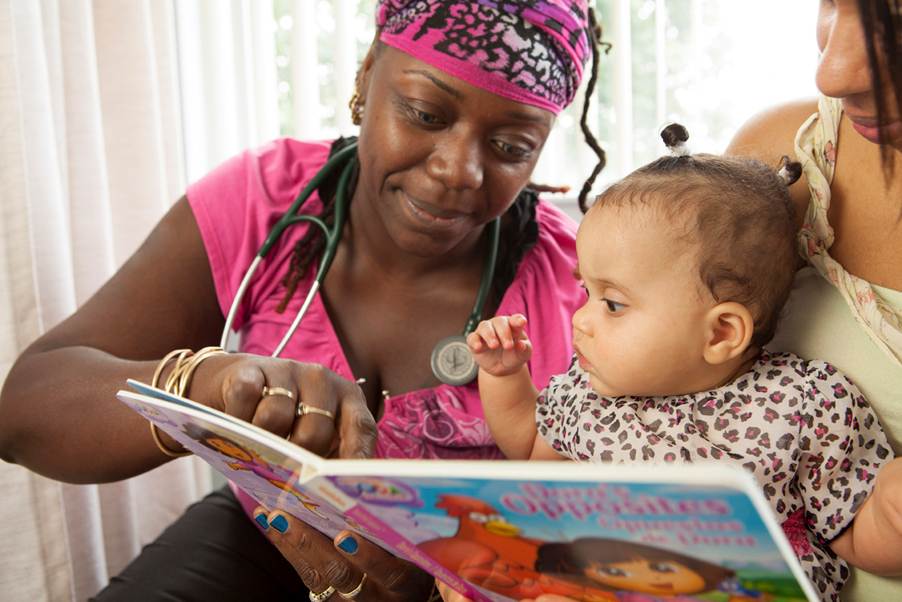
Making something so intimate work across seven states requires infrastructure that rarely appears in the stories families tell. The Louis Calder Foundation’s initial support of three states has grown into a broader effort across five Affiliates and seven states. Expansion is not simply doing the same thing in more places. It creates enough variation to learn what can adapt locally, what must remain recognizable, and what it takes for the approach to become part of the ordinary rhythm of pediatric care.
“What we value about Building Connections Begins at Birth is that it meets families at a moment of enormous possibility and gives them something practical they can use right away,” said Alex Calder, Executive Director of the foundation. “The work is grounded in evidence, but its power is also very human. The real promise is that something as ordinary as sharing a book can become part of how a family comes to understand what their child is capable of.”
Reach Out and Read is using Building Connections Begins at Birth to deepen our understanding of what strong, responsive relationships look like in the earliest months of life. We can evaluate and examine caregiver-child interaction and family experience, building on a growing body of research about relational quality in pediatric care. The work helps us see more clearly how a clinician can follow a baby’s attention, affirm what a caregiver is already doing well, and turn developmental guidance into something a family can see, practice, and carry home.
The work is expanding across states and health systems while asking families and clinicians to pay closer attention to moments almost small enough to miss. The scale is national, but the action itself may be no larger than a baby looking at a page and someone looking along with them.
At CHOP Primary Care in Cobbs Creek, Pennsylvania, Dr. Sharon Sutherland remembers a young father arriving for a well visit with his 20-month-old daughter. The girl was holding her father’s phone. When Dr. Sutherland gave her a book, she put the phone down, became absorbed in the pages, and began babbling.
Her father said, “She tries to read to us.”